

Collection: DOUBLE WALL PAPER CUPS
Ready to put your logo on the cup your customers hold every morning?
KimEcopak supplies double wall paper cups as a packaging and growth partner — not a one-off print order — for cafés, restaurants, and F&B brands across Canada and the US.

-
Custom Printed PLA Coated Double-Wall Paper Cups | Wholesale Canada
Regular price $8,732.00Regular priceUnit price per -
Custom Hot Coffee Cup | Sleeveless & Double Wall | Wholesale | Custom Logo
Regular price $2,692.65Regular priceUnit price per

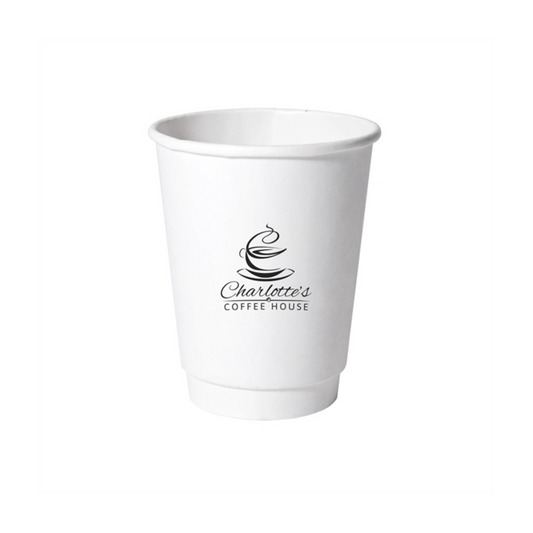
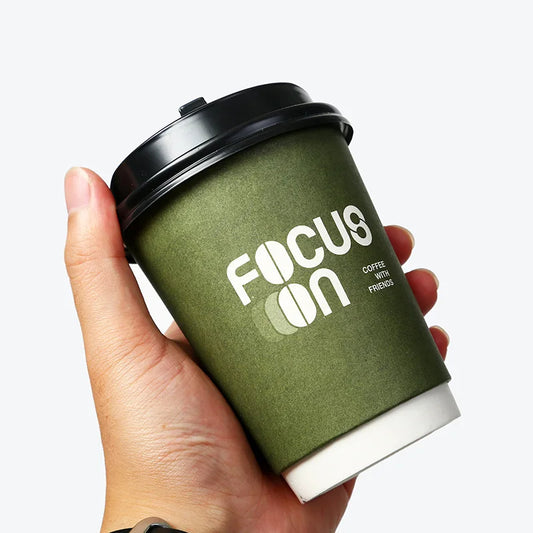
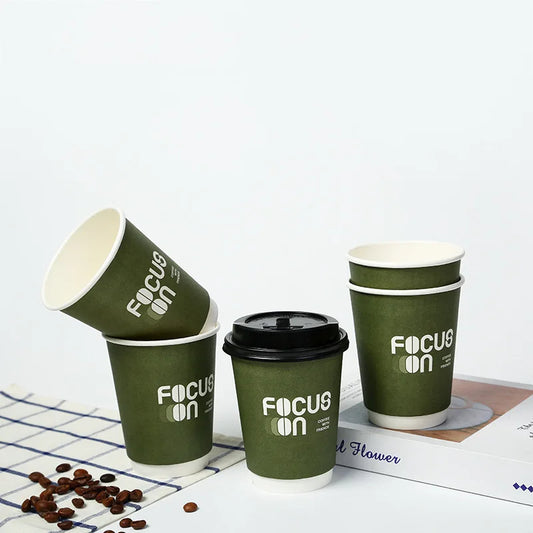
What Are Double Wall Paper Cups?
A double wall paper cup is built from two layers of paperboard fused together with a small air gap between them, rather than a single layer of board with a plastic or wax coating. That trapped air layer is what does the insulating: it slows heat transfer from the hot liquid inside to the hand holding the cup outside, similar in principle to double-glazed glass. The two layers are usually bonded during manufacturing rather than assembled by hand at the point of sale, which is the main practical difference from a cup-plus-sleeve setup, where the two pieces stay separate until a barista puts them together. The inner layer still needs a moisture barrier — most commonly a thin polyethylene (PE) lining, a PLA (plant-based) lining, or a water-based coating — to keep the paperboard from softening when it meets hot coffee, tea, or soup.
Because the outer wall stays smooth, double wall cups also give a cleaner surface for full-wrap logo printing than a corrugated cup, which is one reason they show up so often as the default hot cup for coffee shops, QSR chains, and catering programs across Canada and the US.
The base paperboard itself is usually either bright white or natural kraft brown, and that choice affects the finished look before a single logo is printed. White board gives colors — especially reds, blues, and brand-specific Pantone shades — a truer, more saturated result, which is why most national coffee and QSR brands default to it. Kraft board carries an earthier, "eco" visual cue on its own even before any messaging about materials is added, which is why independent cafés and specialty roasters often choose it deliberately as part of their brand story, separate from whatever coating or lining sits underneath.

Double Wall vs Single Wall vs Ripple Wall Paper Cups
The three formats solve the same problem — keeping a hot drink comfortable to hold — in different ways, and the right one depends on serving temperature, budget, and how much the brand relies on the cup itself for shelf presence. An independent thermal comparison found double wall cups run about 10°F cooler on the outer surface than single wall cups right after pouring (169°F vs. 179°F), though after roughly 10 minutes both converge to a similar internal temperature; a cup sleeve on a single wall cup brought the outer surface down further, to about 130°F, making sleeves the more effective option for beverages served very close to boiling.
| Feature | Double Wall | Single Wall + Sleeve | Ripple Wall |
|---|---|---|---|
| Structure | Two paper layers with a trapped air gap | One paper layer, corrugated sleeve added separately | One ripple wall paper hot cup with a fluted outer layer bonded on |
| Comfort right after pouring | Warm but generally comfortable to hold | Hot to the bare hand; comfortable once sleeved | Comfortable due to textured air pockets |
| Best for serving temp | Standard hot brew, up to near-boiling for short holds | Very hot beverages (sleeve does the most cooling) | Hot beverages where grip and shelf appeal matter |
| Branding surface | Smooth, full-wrap print area | Smooth cup, but sleeve often carries the branding instead | Textured; print area works best on flatter panels |
| Relative cost | Moderate — roughly $0.06 more per cup than single wall in third-party pricing comparisons | Lowest cup cost, plus ~$0.05 per sleeve when used | Typically the highest per-unit cost of the three |
| No sleeve required | Yes, by design | No — sleeve is a separate SKU and a separate labor step | Yes, by design |
In practice, most Canadian and US foodservice operators land on double wall for everyday hot-drink service because it removes the sleeve as a second SKU and a second step at the counter, while still giving a smooth surface for consistent branding. Ripple wall is a reasonable upgrade where grip and a distinctive shelf feel matter more than print clarity, and single wall with a sleeve still makes sense for very high-volume, price-sensitive operations that are already set up for sleeving.
Ready to put your logo on the cup your customers hold every morning?
Share your double wall paper cup needs with the kimecopak.ca team and get a custom quote and free 3D mockup back, no obligation.
Request a custom double wall cup quote →Sizes and Best Uses for Double Wall Paper Cups
Double wall paper cups are commonly stocked from 4 oz espresso shot cups up to 24 oz for large drip coffee or iced hot-hybrid orders, with 8, 12, 16, and 20 oz covering most café and QSR menus. Matching the cup size to the actual drink — rather than defaulting to one size for everything — cuts down on both product waste and customer complaints about half-empty cups. For teams building out a hot-beverage menu, a size-by-drink breakdown like this espresso and latte cup size guide is a useful starting point before placing a first order. It also helps to keep a quick ounces-to-cups reference on hand, since a supplier spec sheet and a recipe card don't always use the same units.
Double wall construction is built for hot service; it isn't necessary — and adds unnecessary cost — for cold drinks like iced coffee, smoothies, or milkshakes, where a single wall cold cup or PET cup already performs well and doesn't need insulation.

Are Double Wall Paper Cups Eco-Friendly? Materials and Certifications
This is worth answering honestly rather than with a blanket "yes." Most paper cups, double wall included, use a thin plastic (PE) or bioplastic (PLA) lining to stop hot liquid from soaking through the board, and that lining is exactly what makes standard curbside recycling difficult in most Canadian and US municipalities — the cup has to be separated into paper and lining at a specialized facility, which most residential recycling streams don't do. PLA-lined cups are compostable, but generally only in an industrial composting facility that reaches the right temperature; they will not break down in a home compost bin or a standard landfill on any practical timeline.
Where a business wants a lighter-footprint option without changing the double wall format, a water-based coating paper cup replaces the plastic lining with a water-based barrier coating, which some regional paper recycling programs accept more readily — it's worth confirming with the local hauler before marketing a cup as "recyclable" on packaging, since acceptance still varies by facility. Select KimEcopak double wall product lines also carry recognized certifications — including FSC-sourced board, BRCGS or ISO 9001 manufacturing standards, and OK Compost or DIN CERTCO compostability marks — though not every certification applies to every SKU, so it's worth confirming which mark applies to the specific cup and coating being ordered.
For a business that markets itself on sustainability, this distinction between "recyclable," "compostable," and "made from renewable material" isn't a technicality — regulators in several Canadian provinces and US states have started scrutinizing vague environmental claims on packaging, and an overstated claim on a cup can create more reputational risk than simply describing the material accurately.
Why F&B Businesses Choose Double Wall for Everyday Hot-Drink Service
Beyond insulation, double wall cups remove a step from a busy counter: no sleeve to stock, restock, or hand to the customer separately, which matters most during a morning rush or at a drive-thru window. They also travel better in multi-cup orders — a filled double wall cup sits more predictably in a drink carrier than a sleeved cup, where the sleeve can shift or slide during handoff. For brands that print on the cup itself rather than a sleeve, the smooth double wall surface keeps a logo and color scheme visible from pour to pickup, which single wall-plus-sleeve setups can undercut if the sleeve gets removed before the customer leaves the counter.
There's also a simpler operational argument that doesn't get discussed as often: one SKU is easier to forecast, order, and store than two. A café stocking single wall cups plus a matching sleeve is effectively managing two inventory lines, two reorder points, and two chances to run out mid-shift. Consolidating to a double wall cup removes that second line entirely, which matters more the more locations a brand operates, since each additional site multiplies the same small inventory-management overhead.
Custom Branding, MOQ, and the Design Process
For F&B businesses that see packaging as part of the brand experience rather than a commodity, KimEcopak positions itself as a packaging and growth partner rather than a print-only vendor. Custom double wall cups can be ordered with a custom logo, brand colors, and design across the cup's full wrap, and — because the goal is helping a brand look consistent as it grows, not just filling one order — minimum order quantities for custom packaging start at roughly 5,000 pcs depending on the specific product and category, which is meaningfully lower than the 10,000+ minimums common at some print factories and keeps custom branding realistic for a single-location café or an early-stage regional chain, not just national accounts.
Every custom order starts with a free 3D mockup before anything goes to production, so a business can see exactly how its logo and colors will look on the finished wholesale hot coffee cup and request changes before committing to a print run. From there, the process is tracked through clearly defined stages — design, approval, production, photos/videos of the actual run, freight, and delivery — so a buyer isn't left guessing where a custom order stands between placing it and receiving it.
This structure is generally aimed at businesses with recurring, ongoing packaging needs rather than a one-time promotional purchase — café groups, restaurant chains, QSR franchises, bakeries, bubble tea brands, caterers, and food producers that expect to reorder the same cup, in the same branding, multiple times a year. For that kind of buyer, a supplier that can also handle bowls, boxes, bags, cutlery, straws, napkins, and other packaging categories under one relationship reduces the number of vendors a growing brand has to manage and keep consistent as it adds locations.

Printing and Design Options for Custom Double Wall Cups
Most custom double wall orders are printed full-wrap in CMYK or spot (Pantone-matched) color, and the practical difference matters when a brand cares about exact color consistency across print runs: CMYK is more economical for photo-style or multi-color designs, while spot color printing holds a specific brand color more consistently run after run, which is usually worth the trade-off for a primary logo color. Finish options typically include matte or gloss coating over the printed area, and either a straight or curved (bevel) rim depending on the cup's diameter and the lid system it needs to pair with.
None of this needs to be decided from scratch — a free 3D mockup (covered below) is the point where color, finish, and layout get tested against the actual cup shape before a print run is committed to, rather than approved from a flat design file alone.
How to Choose the Right Double Wall Cup for Your Business
| Use case | Recommended option | Why |
|---|---|---|
| Drive-thru or high-volume hot brewed coffee | Double wall, PE or PLA lined | Insulation without adding a sleeve as a second step at the counter |
| Sustainability-focused café or B Corp-track brand | Double wall, PLA-lined with compostability marks where available | Supports diversion at facilities that accept industrial compost |
| High-volume QSR already using sleeves | Single wall + sleeve | Lower per-unit cup cost when the sleeving workflow already exists |
| Premium café wanting a distinct shelf feel | Ripple wall | Added grip and texture read as a more premium touchpoint |
| Iced coffee, smoothies, cold specialty drinks | Single wall cold cup (not double wall) | No insulation needed for cold beverages; double wall adds cost with no benefit |
Ordering, Lead Time, and Supply Chain for Canada & US Buyers
Custom double wall cup orders typically run 8–12 weeks by sea freight, or 6–8 weeks by air freight, counted from the point the final design is approved — a timeline worth planning around a seasonal menu launch or a new location opening rather than a last-minute reorder. KimEcopak maintains warehouse space in Canada and the US, which supports both storage between production runs and partial shipments, so a multi-location operator isn't forced to receive an entire order at one address at one time. For businesses sourcing at scale rather than placing a single custom order, this overview of a bulk paper cup supplier in Canada lays out what to expect from procurement volumes and lead times. Beyond cups alone, the broader custom beverage packaging line-up covers cups, lids, sleeves, and carriers as one connected order rather than separate SKUs from separate vendors.
The target buyer for this kind of order is typically a café, restaurant, QSR, bakery, bubble tea shop, caterer, or food producer — especially one running more than one location, where keeping the same cup, print, and supplier consistent across sites matters more than it does for a single storefront.
Frequently Asked Questions
Do double wall paper cups need a sleeve?
No — the trapped air gap between the two paper layers is designed to replace the sleeve for most standard hot-brew serving temperatures. A sleeve is still worth adding for beverages served at or near boiling.
Will a double wall paper cup burn or fail in an oven or microwave?
Paper cups, double wall included, aren't rated for direct oven or microwave use — the lining and the board itself weren't designed for that kind of sustained heat. The specifics of how paper cups and oven heat interact, including why they're not oven-safe, are covered in a separate guide.
How long do paper cups stay usable in storage?
Unopened, properly stored paper cups generally hold up well for an extended period, but coatings and print can degrade with age, humidity, or poor storage conditions. For buyers ordering ahead of a season or in bulk, this breakdown of paper cup expiry and shelf life is worth reviewing before over-ordering.
Are double wall paper cups recyclable?
It depends on the lining and the local facility — see the eco-friendliness section above. A plastic-lined cup usually needs a specialized facility; a water-based-coated cup may be accepted more widely, but this should be confirmed locally rather than assumed.
What's the minimum order for custom double wall cups?
For custom-printed packaging generally, minimum order quantities start at roughly 5,000 pcs depending on the product and category. A business only needing smaller quantities is usually better served by an unprinted or stock-branded double wall cup rather than a full custom print run.
Can double wall paper cups be used for cold drinks?
They can hold a cold drink without failing, but the insulating air gap isn't doing anything useful there — it adds cost without a corresponding benefit. Cold beverages are generally better matched to a single wall cold cup designed for condensation and ice, not heat retention.
Next step: If the goal is a fast reorder, browse the custom coffee cups collection for ready-to-brand double wall options. If the goal is a new custom print run, request a free 3D mockup and a quote based on cup size, coating, and order volume — most first-time custom buyers start there before committing to a production date.
Get your double wall paper cups quoted before you commit to a production run
Tell the kimecopak.ca team your size, coating, and volume needs and get a custom quote plus a free 3D mockup back, no obligation.
Request a custom packaging quote →
TRANSFORM YOUR CUSTOMERS INTO A WALKING BILLBOARD FOR YOUR BIZ
+ RECEIVE $300 OFF FOR 1st CUSTOM LOGO/WHOLESALE ORDER(*)
Share with our experts on your Products, Sizes, and Quantities, and let's cook up a tailored solution that screams YOUR style.
Your vision, our expertise – let's make it pop! Talk to us!
DISCOVER LATEST SHARING TIPS & TRICKS, WITH KIMECOPAK'S BLOGS...
View all-

2026 Is the New 2016: How to Turn Nostalgia Trends into Free Marketing Through F&B Packaging
Have you noticed pastel colour palettes, playful illustrations, Tumblr-inspired typography, and unmistakably "2016-style" designs making a comeback across TikTok, Instagram, and Pinterest? The "2026 is the new 2016" trend is...
2026 Is the New 2016: How to Turn Nostalgia Trends into Free Marketing Through F&B Packaging
Have you noticed pastel colour palettes, playful illustrations, Tumblr-inspired typography, and unmistakably "2016-style" designs making a comeback across TikTok, Instagram, and Pinterest? The "2026 is the new 2016" trend is...
-

Stop Competing on Price: How Limited-Time Offer (or Seasonal) Packaging Makes Your Coffee Shop the One Customers Crave
One of the most effective strategies is Limited-Time Offers (LTOs) or seasonal packaging. This goes far beyond designing a coffee cup. It's about transforming packaging into part of the brand experience,...
Stop Competing on Price: How Limited-Time Offer (or Seasonal) Packaging Makes Your Coffee Shop the One Customers Crave
One of the most effective strategies is Limited-Time Offers (LTOs) or seasonal packaging. This goes far beyond designing a coffee cup. It's about transforming packaging into part of the brand experience,...
-

Emotional vs. Rational Marketing: How to Build a More Effective Coffee Shop Marketing Strategy and Attract More Customers
Most successful F&B brands know how to combine both approaches—using rational marketing to convince customers to make their first purchase while using emotional marketing to keep them coming back.
Emotional vs. Rational Marketing: How to Build a More Effective Coffee Shop Marketing Strategy and Attract More Customers
Most successful F&B brands know how to combine both approaches—using rational marketing to convince customers to make their first purchase while using emotional marketing to keep them coming back.


