The Scale of Chinese Cuisine
To understand Chinese food, you first need to understand its scale.
China has 1.4 billion people across 34 provinces and regions — a geographic area comparable to all of Europe. Because of this diversity, the idea that “Chinese food” is a single cuisine is misleading. In reality, it is a collection of many regional traditions with different ingredients, techniques, and flavors.
Chinese Cuisine by the Numbers
| Fact | Detail |
|---|---|
| Major regional cuisines | 8 (八大菜系) |
| Chinese restaurants in Canada | ~3,000 |
| Popularity in Canada | #1 ethnic cuisine by restaurant count |
| Traditional cooking techniques | 300+ documented |
What connects these cuisines is a shared philosophy: balance. Chinese cooking traditionally aims to balance flavors, colors, and cooking methods, reflecting the influence of traditional Chinese medicine.
Because of this philosophy, Chinese meals are usually communal, with multiple dishes on the table rather than individual plates.
North vs South: The Fundamental Divide
The most basic division in Chinese cuisine is geographic.
- Northern China: wheat-based foods such as dumplings, steamed buns, and noodles dominate.
- Southern China: rice is the staple, along with rice noodles and congee.
This north–south divide explains many of the differences found across Chinese regional cuisines.
The 8 Major Regional Cuisines of China (八大菜系)
Chinese culinary tradition recognizes eight major regional cuisines, known as Bā Dà Cài Xì (八大菜系). Each cuisine developed based on local climate, ingredients, and trade history, resulting in very different cooking styles across China.
Cantonese Cuisine (粵菜)
- Region: Guangdong · Hong Kong · Macau
- Style: Light · Fresh · Ingredient-focused
Cantonese cuisine strongly shaped Chinese-Canadian food culture, since many early immigrants came from Guangdong. The cuisine emphasizes fresh ingredients, delicate seasoning, and quick cooking techniques like steaming and stir-frying.
Famous dishes: Dim sum · Char siu · Wonton soup · Congee · Roast duck
Sichuan Cuisine (川菜)
- Region: Sichuan · Chongqing
- Style: Bold · Spicy · Aromatic
Known for mala (麻辣) — the combination of chili heat and the numbing sensation from Sichuan peppercorn. This powerful flavor profile has become one of the fastest-growing Chinese food trends globally.
Famous dishes: Mapo tofu · Dan dan noodles · Hot pot · Kung Pao chicken
Beijing Cuisine (京菜)
- Region: Northern China · Beijing
- Style: Hearty · Salty · Wheat-based
Influenced by imperial court cooking and northern climate. Wheat staples such as dumplings, noodles, and pancakes are central to the cuisine.
Famous dishes: Peking duck · Zha Jiang Mian · Jiaozi dumplings · Scallion pancakes
Shanghai Cuisine (沪菜)
- Region: Shanghai · Jiangsu · Zhejiang
- Style: Sweet-savory · Rich · Braised
Famous for red-braising (hong shao), a technique using soy sauce, sugar, and Shaoxing wine to create glossy savory-sweet sauces.
Famous dishes: Xiaolongbao · Red-braised pork · Sheng jian bao
Hunan Cuisine (湘菜)
- Region: Hunan Province
- Style: Hot · Sour · Smoky
Often confused with Sichuan cuisine, but Hunan uses pure chili heat rather than numbing peppercorns. Fermented vegetables and smoked meats are common.
Famous dishes: Chopped chili fish head · Chairman Mao’s red-braised pork · Stir-fried pork with peppers

Fujian Cuisine (闽菜)
- Region: Fujian · Taiwan
- Style: Umami · Seafood · Broth-focused
Built around seafood, soups, and fermented ingredients, producing deep savory flavors.
Famous dishes: Buddha Jumps Over the Wall · Oyster vermicelli · Fujian fried rice
Anhui Cuisine (徽菜)
- Region: Anhui Province
- Style: Rustic · Braised · Earthy
Uses wild mountain ingredients such as bamboo shoots, mushrooms, and herbs. Slow braising is common.
Famous dishes: Stinky mandarin fish · Braised bamboo shoots · Mao tofu
Zhejiang Cuisine (浙菜)
- Region: Hangzhou · Ningbo
- Style: Fresh · Elegant · Refined
Known for delicate flavors and high-quality seasonal ingredients.
Famous dishes: Dongpo pork · Longjing shrimp · West Lake fish in vinegar sauce
30+ Must-Try Dishes by Category
Chinese cuisine has thousands of dishes — this table focuses on the ones most commonly found in Canadian Chinese restaurants and those that represent each regional tradition at its best.
Noodles & Rice
| Dish | Chinese | Origin | What It Is | Note |
|---|---|---|---|---|
| Lo Mein撈麵 | 撈麵 | Cantonese | Thick egg noodles tossed with heavy oyster sauce and toppings | Popular in Canada |
| Chow Mein炒麵 | 炒麵 | Cantonese | Stir-fried thin egg noodles — soft or crispy depending on style | Popular in Canada |
| Dan Dan Noodles担担面 | 担担面 | Sichuan | Thin noodles with sesame paste, chili oil, and minced pork | Must Try |
| Zha Jiang Mian炸酱面 | 炸酱面 | Beijing | Wheat noodles with fermented soybean paste and pork | Must Try |
| Congee (Jook)粥 | 粥 | Cantonese | Rice slow-cooked into a silky porridge — the ultimate comfort food | Veg option available |
| Fried Rice炒飯 | 炒飯 | All regions | Day-old rice stir-fried with egg, soy, and additions | Popular in Canada |
Dumplings & Dim Sum
| Dish | Chinese | Origin | What It Is | Note |
|---|---|---|---|---|
| Xiaolongbao小笼包 | 小笼包 | Shanghai | Steamed soup dumplings — bite carefully, there's hot broth inside | Must Try |
| Har Gow蝦餃 | 蝦餃 | Cantonese | Translucent shrimp dumplings — the benchmark of dim sum quality | Must Try |
| Siu Mai燒賣 | 燒賣 | Cantonese | Open-top steamed dumpling with pork and shrimp | Popular in Canada |
| Potstickers (Guotie)鍋貼 | 鍋貼 | Northern China | Pan-fried dumplings with crispy bottom and juicy filling | Popular in Canada |
| Cheung Fun腸粉 | 腸粉 | Cantonese | Steamed rice noodle rolls with shrimp, beef, or char siu | Must Try |
| Char Siu Bao叉燒包 | 叉燒包 | Cantonese | BBQ pork stuffed buns — steamed (fluffy white) or baked (glazed) | Popular in Canada |
Signature Mains
| Dish | Origin | What It Is | Note |
|---|---|---|---|
| Peking Duck北京烤鸭 | Beijing | Lacquered roast duck served with pancakes, scallion, cucumber, hoisin | Must Try |
| Mapo Tofu麻婆豆腐 | Sichuan | Silken tofu in spicy mala sauce with minced pork | Must Try · Veg version available |
| Char Siu叉燒 | Cantonese | Cantonese BBQ pork — roasted with honey-hoisin glaze | Must Try |
| Kung Pao Chicken宮保雞丁 | Sichuan | Diced chicken with peanuts, dried chili, Sichuan peppercorn | Popular in Canada |
| Wonton Soup雲吞湯 | Cantonese | Thin-skinned pork-shrimp wontons in clear broth | Popular in Canada |
| Hot Pot火鍋 | Sichuan / Mongolian | Communal bubbling broth at the table — diners cook their own ingredients | Must Try |
| Dongpo Pork东坡肉 | Zhejiang | Pork belly braised for hours in wine, soy, sugar — meltingly tender | Must Try |
| Sweet & Sour Pork咕嚕肉 | Cantonese-Canadian | Battered pork with pineapple in sweet-sour sauce — a diaspora creation | Chinese-Canadian classic |
Chinese Food in Canada: Authentic vs. Chinese-Canadian
One of the most important distinctions for anyone eating Chinese food in Canada: there are two genuinely different culinary traditions operating simultaneously, and they're both called "Chinese food."
- Regional recipes largely unchanged from mainland / Hong Kong originals
- Found at: authentic dim sum houses, Cantonese roast meat shops, Sichuan hot pot restaurants, Hong Kong-style cafes (cha chaan teng)
- Ingredients: whole fish, offal, preserved vegetables, century eggs, fresh tofu, bitter melon
- Sauces: oyster sauce, fish sauce, fermented black bean, doubanjiang, soy, Shaoxing wine
- Not typically: fortune cookies, broccoli beef as a main dish, extra-sweet sauces
- Cities: Vancouver, Richmond BC, Markham ON, Toronto Chinatown all have excellent options
- Developed by Chinese immigrants adapting to available ingredients and Canadian palate from the 1880s onward
- Found at: most suburban Chinese takeout restaurants, all-day buffets, mall food courts
- Distinctly Canadian Chinese dishes: Ginger Beef (Calgary invention), deep-fried shrimp toast, western chop suey, egg rolls with coleslaw filling
- Sauces: heavier, sweeter, more cornstarch-thickened than authentic versions
- Fortune cookies: invented in San Francisco, not China — most Chinese people in China have never seen one
- Still delicious on its own terms — it's a legitimate cuisine, just a different one
🍁 A genuinely Canadian Chinese invention — Ginger Beef: Calgary's most famous Chinese-Canadian dish was created in the late 1970s at the Silver Inn restaurant on Centre Street. Chef George Wong deep-fried thin strips of beef until crispy, then tossed them in a sweet, gingery sauce — a technique that had no direct Chinese precedent. Ginger beef spread across Alberta and Western Canada and is now a fixture of Chinese-Canadian restaurant menus, virtually unknown outside Canada. It's a useful example of how diaspora cuisine develops: genuinely creative, shaped by local ingredients and tastes, distinct from its source.

Why Cantonese Cuisine Dominates Canadian Chinese Restaurants
Walk into most Chinese restaurants in Canada — particularly those established before 2000 — and you're eating Cantonese food, whether the menu says so or not. This is not an accident of taste. It's a direct result of immigration history.
The first large wave of Chinese immigration to Canada came during the 1880s gold rush and the construction of the Canadian Pacific Railway. These immigrants came overwhelmingly from Guangdong (Canton) province, bringing Cantonese language, culture, and food. For nearly a century, Cantonese immigrants established the Chinese restaurants, grocery stores, and food supply chains in Canadian cities. The entire infrastructure of "Chinese food" in Canada was built by Cantonese people.
This is why, to most Canadians, "Chinese food" means dim sum, char siu, wonton noodle soup, and Cantonese-style stir-fries — not Sichuan hot pot, not Beijing Peking duck, not Shanghai soup dumplings. Cantonese cuisine's emphasis on fresh ingredients, subtle seasoning, and delicate technique also made it genuinely approachable to non-Chinese customers in a way that, say, Sichuan's numbing heat might not have been in the 1950s.
💡 Dim sum as a cultural institution: Cantonese dim sum (飲茶 — yum cha, meaning "drink tea") is not just a meal format — it's a social ritual. The tradition of gathering with family on Sunday mornings to share small plates and tea dates back centuries in Guangdong. In Vancouver and Toronto, dim sum restaurants that seat 300–500 people are completely packed by 9am on weekends. For Chinese-Canadian families, this is not a restaurant outing — it's how families stay connected across generations.
The Sichuan Boom: Why Mala Flavors Are Everywhere Now
The last decade has seen a dramatic shift in Canadian Chinese restaurants. Sichuan cuisine — which was barely present in most Canadian cities before 2010 — is now one of the fastest-growing food trends in Toronto, Vancouver, Calgary, and Edmonton.
The shift was driven by a second wave of Chinese immigration: mainland Chinese immigrants, predominantly from Sichuan, Chongqing, Hunan, and other non-Cantonese regions, who came from the 1990s onward and brought demand for the food they grew up eating. Today, nearly every major Canadian city has multiple Sichuan hot pot restaurants, mala tang (麻辣烫) shops, and dan dan noodle specialists.
The flavor profile — mala (麻辣, numbing-spicy) — is genuinely addictive. The Sichuan peppercorn (花椒) contains hydroxy-alpha-sanshool, a compound that directly stimulates nerve endings responsible for touch and vibration sensation, creating the characteristic buzzing numbness. Combined with capsaicin from chili peppers, the effect is unlike anything in Western cuisine or other Asian food traditions.
📌 The most important Sichuan dishes to know for Canadian restaurant owners: Mapo tofu (麻婆豆腐), dan dan noodles (担担面), twice-cooked pork (回锅肉), Sichuan-style hot pot (重庆火锅), and fish-fragrant pork slivers (鱼香肉丝 — which contains no fish but uses the sauce combination that typically accompanies fish). If you're opening a Sichuan restaurant in Canada, these five dishes establish your credibility with Chinese customers who know the cuisine.
How to Order at a Chinese Restaurant Like You Know What You're Doing
Chinese restaurant menus in Canada range from fully bilingual to Chinese-only, and even the English menus often assume some familiarity with the cuisine. These are the practical things worth knowing before you order:
| Situation | What to Know |
|---|---|
| Dim sum ordering | The traditional method uses carts — flag down the cart lady and point at what you want. Many restaurants now use paper order forms instead. Order 2–3 items per person minimum; everything comes as a shared table dish. Har gow and siu mai quality is the benchmark — if these are good, everything else will be good. |
| "Authentic" vs takeout | If the menu includes items like bitter melon, duck blood, chicken feet, or century eggs, you're in a more authentic restaurant. Menus that only list sweet & sour chicken, fried rice, and spring rolls are targeting a non-Chinese clientele — still good, just different expectations. |
| How many dishes to order | Chinese meals are communal. A standard formula: one dish per person, plus one extra, plus rice or noodles. A table of four orders 5 dishes. Dishes arrive as they're ready, not in courses. |
| Tea etiquette | At a Cantonese restaurant, tea arrives automatically and is refilled throughout. Tapping two fingers on the table (index and middle finger bent) is the traditional Cantonese gesture to thank the person pouring tea without interrupting conversation. |
| Asking for "less spicy" | At Sichuan restaurants, spice level is usually customizable (mild / medium / spicy / extra spicy). "Less spicy" is a common and completely normal request — chefs adjust. "No Sichuan peppercorn" is also sometimes requested by those who don't enjoy the numbing sensation. |
| Sharing plates | Chinese dining is designed around sharing — there are no "individual" main courses. Every dish is placed in the center of the table. Using chopsticks to serve others (particularly elders) before serving yourself is the traditional show of respect. |
Packaging Considerations for Chinese Food in Canada

For restaurant owners, different Chinese dishes have dramatically different packaging requirements. Getting the container wrong doesn't just affect presentation — it actively degrades food quality.
REQUEST A QUOTE OR GET FREE SAMPLES FOR PACKAGING TODAY!
Noodle Dishes (Lo Mein, Chow Mein, Dan Dan)
Noodles continue absorbing sauce in the container — saucy dishes like lo mein hold better than dry stir-fry noodles. Need a container that's leak-proof (sauce pools), heat-retaining, and vented for crispy variations.
→ Explore containers with tight-fitting lids work bestDumplings & Dim Sum
Steam is the enemy of dumpling quality — it softens the skin and destroys crispy potsticker bottoms. Vented lids are essential. Soup dumplings (xiaolongbao) need extra care: packaging must prevent them from sticking together or tearing.
Peking Duck & Roast Meats
Peking duck skin begins losing crispiness within minutes of plating. For delivery, separate the components: duck skin and pancakes separate from the meat. No steam — vented packaging only. Roast meats (char siu, roast pork) hold better but still need ventilation.Hot Pot Broth & Soups
The heaviest requirement: broth containers must handle near-boiling liquid (95°C+), be completely leak-proof under pressure, and not transfer plastic taste. Many standard foam containers are not designed for sustained high-temperature liquids.
→ See kraft paper soup cupsFried Rice & Congee
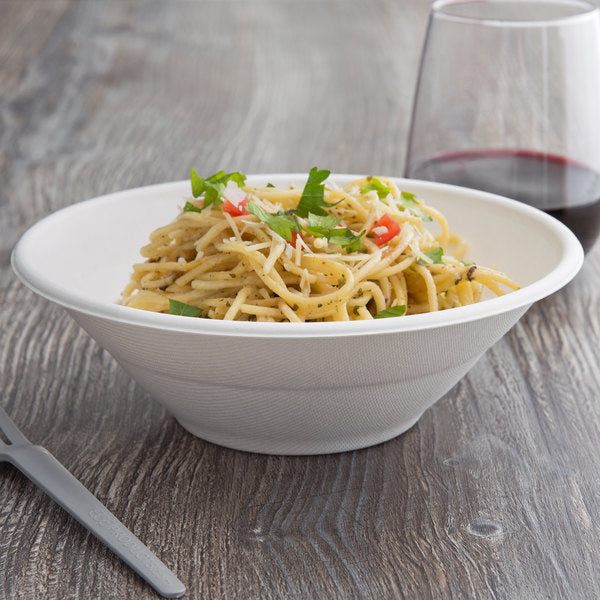
Fried rice holds well — it's a dry dish that doesn't degrade significantly in transit. Congee needs a proper seal to prevent spilling as it's liquid. Both are suitable for compostable bagasse containers which handle the moderate heat and weight well.
→ See standard takeout boxes for fried riceStir-Fry Mains (Kung Pao, Mapo Tofu)
Saucy stir-fries need leak-proof containers. Mapo tofu is particularly challenging — the silken tofu breaks if the container is moved roughly, and the spicy oil separates and pools. Wide, shallow containers reduce tofu breakage; containers must handle chili oil without discoloration.
The eco packaging shift in Canadian Chinese restaurants: Chinese restaurants historically used Styrofoam containers heavily — they're cheap, heat-retaining, and oil-resistant. But municipal bans on single-use plastics and Styrofoam across Toronto, Vancouver, and Montreal are driving a rapid shift. Bagasse (sugarcane fiber) containers have emerged as the practical alternative: comparable heat retention, oil resistance, and leak resistance, fully compostable. The upfront cost is higher but the regulatory risk of non-compliance and the brand perception benefit make the switch economically sensible for most Canadian Chinese restaurants.
Frequently Asked Questions: Chinese Food
What is Chinese food?
What are the most popular Chinese dishes in Canada?
In Chinese-Canadian restaurants: fried rice, lo mein/chow mein, sweet & sour chicken or pork, spring rolls, wonton soup, and General Tso's chicken (a North American invention). In authentic Chinese restaurants: dim sum (har gow, siu mai, xiaolongbao), char siu, Cantonese roast duck, mapo tofu, dan dan noodles, and hot pot. The two lists overlap less than most people expect.
Is Chinese food healthy?

What is the difference between Chinese food and Chinese-Canadian food?
Why is Chinese food so popular in Canada?
What is mala flavor?
Are fortune cookies Chinese?
Conclusion
Chinese cuisine is incredibly diverse, shaped by geography, local ingredients, and centuries of cultural history. Rather than a single style of cooking, it includes many regional traditions from the light, ingredient-focused dishes of Cantonese cuisine to the bold, spicy flavors of Sichuan and the rich braised foods of Shanghai.
In Canada, Chinese food has evolved into both authentic regional cuisines and Chinese-Canadian adaptations, reflecting more than a century of immigration and cultural exchange. Understanding these differences helps diners appreciate the cuisine more deeply and helps restaurant owners create menus that balance authenticity with local tastes.